• It’s been nearly two weeks since I’ve written anything but fiction. I have had my head down, typing away at my manuscripts, holding on to my last bit of sanity as I dive into voices and people and journeys that are not my own. Some of these characters are not even my own species (won’t get too deep into that just yet, but my last post certainly delves into my love of anthropomorphic woodland creatures who harbor more humanity than do most humans).

    Beyond writing, I have been reading. Devouring, really. A few titles as of late: When the Sky Falls: A Human History of Shooting Stars by Jade Angeles Fitton, A Frozen Woman by Annie Ernaux, Mestra, a short story by Madeline Miller.

    I also finished a book that somehow dodged my high school syllabus: Aldous Huxley’s Brave New World. American high schools tend to divide themselves into two camps: those who read Brave New World and those who read 1984. I haven’t met many who read both in class, as dystopia is not a very “fun” topic and I don’t think it holds well the attention span of most high schoolers (after all, most of us don’t think that what’s in those books is ever going to happen, and we rarely realize that it already has). My high school was on the 1984 train, and I’m thankful for that, as I think my teachers would have had a very hard time keeping the class under control while Huxley shouted “orgy-porgy” every other line.

    Having read Brave New World later in life than most, I have several thoughts that will take further time to mull over, to figure out. I love it and I don’t. Not that my opinion really matters. It’s a masterpiece, and it is strange. I’m not sure that what it says means what I think it does. But I am happy to have read that Huxley himself was not wholly satisfied with his ending in later years. In the edition I read, Huxley bemoans the fact that he did not have a “third way” between “civilization” and “savagery,” and I think that thought comes only from maturity and the ability to look back and scrutinize one’s own work.

    Two very specific passages from this book, however, remain beautiful and true, and they are thus:

    “That mania, to start with, for doing things in private. Which meant, in practice, not doing anything at all. For what was there that one could do in private. (Apart, of course, from going to bed: but one couldn’t do that all the time.) Yes, what was there? Precious little.”

    And, further down the page:

    “‘Then what’s time for?’ asked Lenina in some astonishment.

    Apparently for going [on] walks in the Lake District; for that was what he now proposed. Land on top of Skiddaw and walk for a couple of hours in the heather. ‘Alone with you, Lenina.’

    ‘But, Bernard, we shall be alone all night.’

    Bernard blushed and looked away. ‘I meant, alone for talking,’ he mumbled.

    ‘Talking? But about what?’ Walking and talking–that seemed a very odd way of spending an afternoon.”

    Walking and talking, being alone by oneself or being alone with someone who you love and who is therefore a part of you. Being alone without it being lonely at all. Being alone to read books like this very one that bemoans the world we’ve made for ourselves while that very world turns outside of your room, furious and hurried and gorging and angry.

    What I’ve been doing these past few weeks is remembering the art of being alone in a world that, since Brave New World’s publication in 1932, has only accelerated this communal frenzy.

    What I don’t think Huxley could have foreseen, nor anyone, for that matter, is social media, something I deem to be one of the greatest evils of our time. Caveat: I use Instagram, and I hate that I use it. But it is how I keep tabs on bookish news, how I follow my favorite writers and illustrators, and, unfortunately, how I fritter away my time. I’m actively working on rectifying that latter bit. But we all have our vices, don’t we?

    But I’ve been reading quite a bit about the societal effects of social media, on how it has skewed our morality, our sense of self, the very notion of aloneness.

    One book I recently read that skates along these lines, though it was also published before the rise of social media, was Neil Postman’s Amusing Ourselves to Death. There was a very particular part of this book, though I have no direct quotes (forgive me), that defined the current social currency in far clearer terms than I myself have ever thought about it. Money is no longer the sole catalyst behind what we, as a society, define as “success.” Now, too, fame must be involved. Not fame as in A-listers, not fame as in Nobel Prize winners. Fame as in that five-second clip that drives one to a week-long, maybe month-long, internet stardom.

    I was discussing with my husband only the other day how quickly internet fads come and go. How everyone knows a specific video or meme or saying, how these people shoot from nothing into glorious golden light, and then, their usefulness exhausted, they fade out just as quickly. They are used, abused, forgotten. It doesn’t really matter what they did or said in the first place. It was probably funny or shocking. Maybe even obscene. I can almost guarantee that it was not profound. But it did hold our attention – a rare occurrence in a society of depleted attention spans.

    Fame comes at many levels, though. You do not have to go “viral” to receive an ounce of attention. What social media has done has accentuated the need for us to post about what we do and what we think (take this blog, for example) because, without this evidence, without this cultural and societal approval, it is as if we haven’t done or thought at all. Why hike if you don’t show the mountain, show the calories burned, show that you are of a certain brand of person who delights in the natural world and so identify with all that goes along with it (Patagonia jackets, granola, craft beer). I’m joking, but I’m also not.

    We so rarely take a walk in the woods for the sake of it. A thought of delight hardly ever enters my head without the simultaneous need to share it with my friends. After a long day of writing, if I’ve found it successful, I want to gloat. If it’s been miserable, I want to moan. We, I, can hardly do anything alone these days. The mystery has flown.

    So even in these past few weeks where I have been more alone than I have in some time, I was not alone at all. I’ve posted the dog, the bluster of the beach, birds and quotes and books that I find say something not only to me but about me. And for what?

    It’s all very strange, isn’t it? Who really gives a damn?

    And yet, here we all are. Sizing each other up in a matter of nanoseconds. Putting ourselves into boxes labeled Interests, labeled Aesthetic.

    This is only evolutionary, I’ll give it that. We’re a communal species. We need each other. But the constant scrabbling for attention has missed the mark of the true definition of community, what it means to be each other’s greatest advocate without the infinitesimal scrutinizing of the online feed. No wonder I close Instagram with a migraine almost every time. How can the brain that’s just understood fire fully understand the virtual world?

    To be private, to really take yourself from out of things, to not have everyone know what you are doing all the time, that is the ultimate rebellion. We are in a society of surveillance, in so much as our internet traffic is tracked, our daily movement seen through CCTV, through Flock footage that scans our license plates. God, and those Ring Cameras. Every time I walk the dog I hear that chime and that nasty voice drawl, “Recording in Progress.” This isn’t to say I’m a Luddite, that it’s all bad. But it is something to be aware of and to acknowledge. How quickly this can all turn sour.

    I guess the solution is to make oneself unavailable, in so much as it is possible. The less I rely on the internet, the less data there is to mine. The more I write long-hand, the fewer words AI can scrape (I’m looking at you, Google Docs, Word, yes, even you, WordPress). I can do nothing about being watched by others, but I can make my interactions mean something.

    And let us create.

    Make yourself a being of creativity.

    Create something from nothing in a world that thinks it knows your every step.

    That last bit reminds me of Wendell Berry’s poem, “Manifesto: The Mad Farmer Liberation Front.” His final stanza has the great clarion call to uniqueness, to personal oddity.

    “As soon as the generals and the politicos
    can predict the motions of your mind,
    lose it. Leave it as a sign
    to mark the false trail, the way
    you didn’t go. Be like the fox
    who makes more tracks than necessary,
    some in the wrong direction.”

    Take a walk, make tracks. And if you must talk, talk to your loves, talk to yourself. I know I do.

    And so what if it’s odd? At least it’s your own oddity. As the future has grown so close to Huxley’s predictions in so many ways, mere aloneness is subversive.

    This is what I’m telling myself in order to get through a life dedicated to the loneliest profession of all: the writer. And in writing, I hope to practice Berry’s final line in his poem, the line which states simply, states with a government of hope:

    “Practice resurrection.”
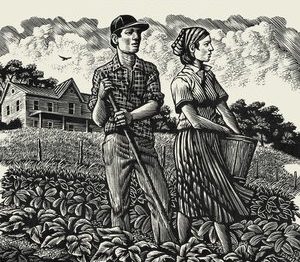
    Image from the cover of Wendell Berry’s Roots to the Earth, illustrated by Wesley Bates.
  • Good books come like asteroids, shooting through and out your life, their tails raw and glimmering long after the phenomena itself has passed. Years of work, tears, toil – we read books in only a day, a week, a month. It flashes against and upon us, and then we move on. But it is what stays with us that is important and why, at least for me, I continue to write when doors continually open down the hallway of my imagination and I think that I’ll never get out of it.

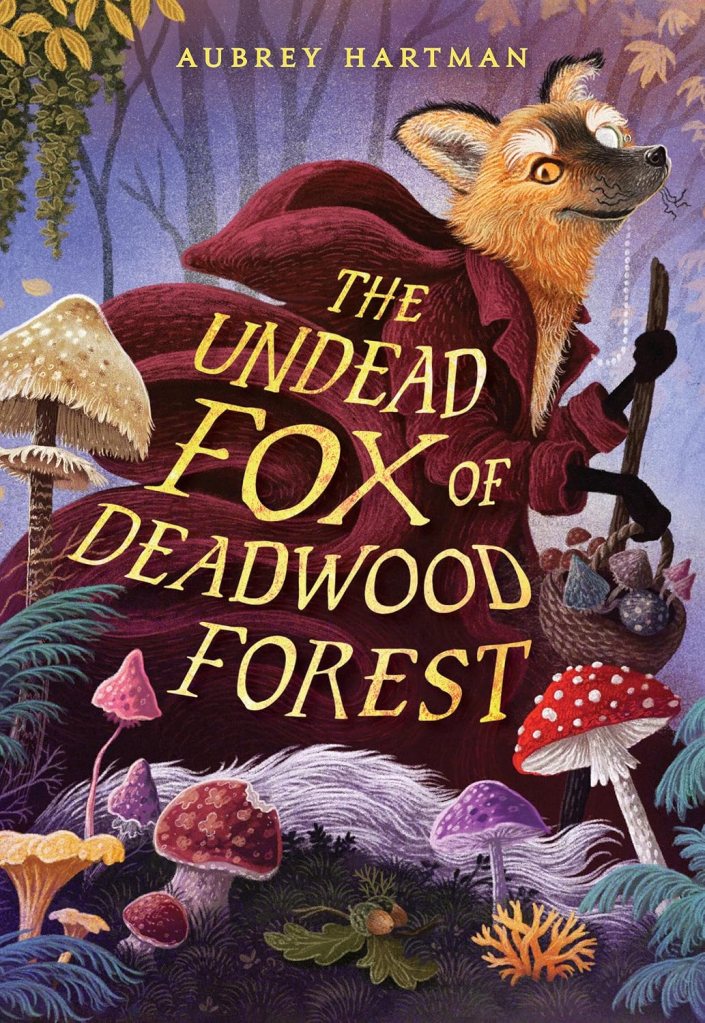
    A few comets in my life: Small Things Like These, Claire Keegan, The Sea, John Banville, and all poems by Heaney and Kavanagh. Recently I found myself crying until I wheezed over a book meant for children, Aubrey Hartman’s The Undead Fox of Deadwood Forest. I’m not quite sure it was ever meant to be that heartbreaking, or maybe I just read it in that vulnerable blip of time where the body winds down from a hard day and eases itself into rumination on everything rough and cruel: how hard it is, these days, to live and breathe in a world with such abject poverty, illiteracy, contempt for the other (see: librarianship). But it went through me as only grief can, and when I’d finished my crying and made a cup of tea, I was astonished at how buoyant I felt. Something had come and gone and had left me with a gift that surpassed my understanding. Catharsis, or more accurately, the emotional sign of a book well-written.

    This book, like so many books written for children, features anthropomorphized animals in cloaks and monocles, mushrooms fields, the relationships of unlikely creatures who find meaning in difference (a badger and a fox, for one). It is precisely these elements that make a children’s story entertaining and suspend reality for long enough to get a message or two across, whether they be messages that life is not always kind or that children’s stories should not have messages at all because much of life doesn’t have a message, except maybe the lesson that we are alive and that it is important to always remember that knowing you’re alive is easily forgettable.

    The Undead Fox of Deadwood Forest, Aubrey Hartman (Little, Brown 2025)

    It’s why one of current works in progress is a children’s books meant for readers who are just now growing into their personhood, realizing that they are a part of a greater community of creatures (both human and otherwise) and that the world is more strange and more beautiful than perhaps parents – and other jaded adults – make it seem. It is these books (usually read between the ages of 6 and 12) that directly influenced my interest in the natural world and in folklore, and so I suppose it’s not strange at all that a book like The Undead Fox of Deadwood Forest had me crying big, joyous tears that I could not explain away.

    The book is not only about life’s greatest quest, death, but about respect and preservation of the natural world. I don’t give anything away by saying that there is a heartwrenching scene wherein destructive, loathsome children come upon a pristine setting, and like we see in Adams’ Watership Down, the clash of chaos and peace is never a nice one. We know destruction for destruction’s sake is wrong, and yet every day we commit these very crimes.

    What my writing is, in general, is apology. It is a grasping at knowing what I’ll never know in regards to how deep and how long my personal destruction has been. So much of the world burns safely away from my sight. This emotion, this “climate doom” goes so deep in and far from me that the only thing I can do is read about anthropomorphic foxes going about their daily business, watching them in their impossible worlds balancing life against death and knowing themselves fully as animal.

    And so, I’ve decided to share poem I wrote for the natural world. A love poem. A poem that I edited heavily after reading Aubrey Hartman’s book, so a thank you to her, though she’ll probably never see this. A vibrant comet amidst decay.

    For the Earth-Spirit

    No, I do not think the good of you is diminished
    in the house of the world, that the things that have
    flown their arrows at you make you any less
    you as if every point could rip holes through and out,
    and by them, I could see the sun easting
    over the horizon and thereby could not see you for shadow.

    No, I do not think that what has been done to you
    comes more naturally than what could be done,
    and as I read this poem by a tree on the bank
    of a dead river, I do not think it does good at all
    except that I love you for what’s existence,
    your sway away and toward everything.

    Yes, and the fact of your holiness, I watch it rise
    and go before me, arch my every to see it through,
    the backside of my shadow, the mossy ground
    (your sheltering body)
    and in this dark, fern unfurl and through them
    I walk and give thanks to what I think I know is true.

  • The What For

    What’s the point of it, this writing?

    What’s the point of sitting bare and naked against your thoughts and making something of them, especially if no one but yourself and a close cohort of others reads it? What is this insatiable human need to create, and why me?

    How many questions can I ask myself and how much guilt can I pile onto my heavy-laden shoulders when another day goes by and I have not created, only consumed, and I feel the black-hole-vacuum-pull of meaning leaching from me? How more poetically can I ask myself why I am the way I am and why was this world not made for the likes of you and art and me?

    I work because I must pay my bills. I work at a library which is, though often a chaotic and convoluted and even violent place, as close as I can get to the dissemination of art while still making enough money to keep the lights on.

    But in some perfect world I would do nothing but write; I would sit at the desk and watch the world in its frenzy go by and give the dog a pet and spit out reams of words until I was too exhausted to string a cohesive thought. But that is not the way of the world and maybe that is not an ideal world at all – a writer must be in the world to write of the world. And then, the thought, what good is this at all?

    At the library, I am confronted daily with a) those who read and crave knowledge and b) those in crisis. Find me on a good day and perhaps I can solve the majority of the issues I am confronted with or at least point people in the direction of a solution and so go to bed knowing that I did something good or useful or, here’s that dreaded word, productive.

    If, the next day, I don’t work and so spend some hours writing, I have something close to a sense of accomplishment, but I do have something dragging me, too, like a kelp-entwined anchor scratching at the sand. What was the point of that? And what good did it do anyone? And there’s the idea that it did no good to me, even, because there’s every chance that the next day I’ll go through with a red pen and strike it all out. I’ve restarted my current novel(s) at least five times (each) and I plan to start one over again, if not from scratch, from something close.

    Productivity, then, is what I view and have viewed as success, and it is in putting that into words that I pause and become afraid of that thought. Why do I write if I don’t think it is productive? What is the point? What is the what for?

    There must be something intrinsically necessary about creating art in a world dominated by the need to make money, expand, grow. There must be some reason that I continue to strive for perfection in my novels (otherwise, I would have cranked out about a dozen manuscripts, I expect. Seems like many fast-fashion writers are doing that and getting rich by it). But there is something glimmering and deeper than the need to have a finished product, and though I have made no money by my writing, I am still working hard toward some opaque goal. Take this blog, for example. I have had hundreds of viewers (of which I am grateful) but I will not and do not want to make money by it. Then why do it?

    And why, simultaneously, do I feel that I have not had a productive day if all I do is churn out words that no one will read?

    Holding two things at once: a dream and a reality.

    We have all been bred to view creativity as non-productive because it does not serve the greater machine. Most art will never be circulated. It is an entirely selfish act, no matter how much artists create work that is political or oriented toward justice. It is entirely selfish because it demands the artist be with only themselves for a set amount of time, writing their opinions on the opinions of others and not answering calls or texts or the blips of social media that cry out for attention.

    Which brings me here: art, at one time, in some distant place, was once cherished, surely. I’m not trying to set some Golden-Age standard, but I do think that art has cheapened. Not the artists themselves, no. Fast-fashion art has always been around, and much of it has actually stood the test of time and found itself canonized. No, I think art – writing – has become cheapened in the sense that we live in a society based on the idea of consumption and so art has become another spoke in a great wheel that is running away from us down a mountain with no brakes. Art is deemed extraneous and something to be gorged upon. When we are done, we rate it, we move on, we look for the next thing to take us from out of ourselves and out of a dreary world.

    But when you stop and remember how beautiful this world is, art, inevitably, becomes necessary again.

    I like to say that our little ape brains have not caught up with this economic system that has divorced us from the need to be really productive, that is, the need to make things, specifically with our hands and imaginations. This is one reason we are so anxious and depressed. Nothing is demanded of us anymore that speaks to who we are.

    What I’m saying is that I have been trained to view my writing as extraneous. As non-productive. As frivolous.

    As the moon turned into my thirtieth birthday, I decided that I would escape this. I have not, but I have made progress (funny word to use here). I at least recognize now, and perhaps this is only thanks to the rise of AI, that writing – and creativity in general – is an act of rebellion. It is a completely selfish act, it is the complete submission into reality, it is the fulcrum that forces you confront the frightening and delicious notion that you are wholly alive and a part of something greater.

    Creation is the employment of those whose souls are still intact.

    I’m giving myself and creatives a very high opinion, but I am doing so to make myself feel better on this day when I sat down to my novel and found that I could not write five words without feeling that overwhelming dread of why.

    This is, I suppose, a little love letter to myself. And a response to a very old poem of mine that I had long forgotten about. It was a poem written around Christmas, I remember. A poem written when I was missing my grandparents fiercely, and I imagined what it was they would say to me if their ghosts came riding the flames of our Christmas hearth. I imagine I was reading Dickens’ Christmas stories at the time to think of such a thing.

    I had this notion that my grandmother would tell me to live a bit more, to quit pining over myself and the meaning of it all. To keep writing, of course, but to see its connection to the greater good, to the ever-growing rout of writers who defied it all and did what they wanted and were poorer for it but happy.

    Here’s a poem, then. Be joyous.

    The Visit

    Frances, don’t look at me like that.
    I know the floor has its dust
    I know the pot boils
    I know every inch of my potential
    that has fizzled out on long nights
    of fear. I know the energy
    it must take you
    to come back at the Christmas hearth
    and ask what I’m doing with this one life.

    What of yours, Frances?
    The war and the farm and the road unpaved.
    I know no pacifists. We’re all and about all
    depraved. But that white hand holds
    up says no, I mean what are you doing
    here, now, with all these pages.
    (You can’t reject our sacrifices,
    they’re done.)

    What are you here, ripping
    this life into lines?
    Have you lived, has the sun ever come up your door,
    have you felt it on the face we gave you
    the culmination of our all–
    Are we, to you, just a dream?


    It’s too late for sleep,
    grandaddy rides the next flame.

  • To create is to be rejected. That’s the way it is and that is how it always will be. It is the scourge of creatives; it is the bane of the writer’s life, specifically, who receives rejections almost on a daily basis. It is also the writer’s greatest teacher.

    Like every good writer, I keep tabs on my submissions. I started by hand and when things got out of hand, I shifted the data into an excel spreadsheet which, though lifeless, does help me immensely. I didn’t start this online tab until, let’s see, February 5, 2023 when I submitted to a local journal, Surge: The Lowcountry Climate Magazine. My non-fiction piece, Wadmalaw Longing Song was accepted for publication, and that initial surge (no pun intended) of electricity that the acceptance gave me made me think, even though I had been out of my MFA for two years and had only submitted to a smattering of magazines, that maybe I really could write and maybe I should get my butt down to business to achieve the dream I had always had since I’d first learned to put letters to paper. 

    And, since then, I have documented 146 submissions, 23 of which are still in limbo, sporting that haunting “in-progress” button on Submittable. This also means that, besides my three – three – acceptances, 120 of those are rejections. Compared to most, that’s nothing. And the only reason that number isn’t higher is that I go through phases where I submit nothing at all, needing a break from the bureaucracy of it and, well, the fees. 

    And so, if we remove those 23 in-progress submissions (which all, statistically, will be rejections), I have a current acceptance rate of about 2.5%. 

    Thus, I am no stranger to rejection. These days, I hardly register those “We’re sorry to inform you…” emails. They are filed into a specific folder on my email account, are documented on my spreadsheet, and are duly forgotten. But, sometimes, I get something really good.

    There are “good rejections,” a term that my friends and I joke about. What other profession can have “good” and “bad” rejections? For example, I have received rejections that are personalized, sincerely hoping that I’ll submit other work because xyz story or poem was not quite there, but my work was, nonetheless, high on their radar. There are also those that inform you that you made it to the final rounds of a competition or that they are simply intrigued by your writing style. 

    And then there are some that actually make me laugh out loud. Rejections that make an impact.

    I submitted a poem as a bit of a Hail Mary to an academic journal that, every now and then, publishes creative work. I will not name that journal because it is a respectable one that publishes great work, specifically in the field of folklore (about which I am very passionate).

    And so I submitted a poem of mine about selkies, a specific folkloric creature with which I am a bit obsessed. Both of my current novels have, you could say, elements of the selkie, and this poem was written from the perspective of the traditional selkie woman. Quite in the vein of their other creative works, I assure you.

    What I received back was a rejection, of course, but also a rubric. I had forgotten that academic journals sent out rubrics…it’s been a few years since my undergraduate days when I was forced to submit my capstone paper to a journal (yikes). So I was tickled to have one sent to me. And even more tickled to have it say this:

    “[The poem] might evoke emotional tension but the questions, the half-dialogue and thinly veiled pretence irritated me.”

    Moving down the rubric, I then read:

    “I found [the narrator’s] silly denial (the ‘chokehold’ bit in particular) quite unpleasant rather than someone I could sympathise with.”

    If this isn’t the greatest rejection one could receive, I don’t know what is.

    To have my piece, a poem entitled “Selkie Song,” labeled not only as “irritating” but “quite unpleasant” is perhaps the greatest compliment. It is a compliment because that is exactly what I was meaning to achieve in the poem. It is not a nice poem, it is not a comfortable one. It is a poem about domestic abuse in regards to the selkie legend and it is about the horrific ways in which society smiles upon women loving their abusers and – well, if you read it for yourself, you can clearly see what it is about. If I’ve learned one thing from my many workshop classes, it’s that you should never explain the “why” of what you wrote. You won’t be able to hover over your reader’s shoulder as they read your work, so let the writing do the talking.

    Perhaps my poem really is bad, and maybe it makes no sense, and maybe it falls flat in what it is trying to achieve. But as to that last bit, I can’t help but think that’s not the case. It angered someone, I mean really got them riled under their skin. I don’t think my writing has ever riled anyone, and so to have someone quite literally be irritated with my work was joy. 

    It was also the moment I realized that writing, though a solitary act, was not a solitary art. Patti Smith, one of my many muses and inspirations, said this over and again in her writing. 

    “Writing is not some quiet, closet act.” 

    But at the same time, and with the same fervor, she writes, in M Train,

    “I wrote to give myself something to read.”

    Writing is this insane, masochistic ledge between writing exactly what it is that you want to read and writing for others to read. It is writing because you – and others –  can’t find this exact work anywhere on bookstore shelves because only you could write it (and you haven’t, because you keep putting it off by finding better things to do). And at the same time, writers – all artists, I think – have an innate need to share their work, as every story, every poem, every word is a dialogue with the world at large. And so, it is not some “quiet, closet act.” It will always involve others and involving others involves opinion and opinion involves friction.

    But you have to write anyway, because you were born to do it. If I did not write, I would be a husk of a human. I would not know where to put my thoughts or my love. I would wander aimlessly through a reality that I could not make sense of because I did not have the very thing with which to make it make sense. Does that make sense?

    Anyway, that’s my rumination on rejection: enjoy it. Every rejection makes you stronger. Not numb. Just less pervious (but not impervious). Rejection, too, can show you exactly what you’re doing wrong. It, too, shows you what you’re doing right.

    Either way, you must do it in the first place.

    So, here it is.

    Selkie Song

    Miss what, home? You think I’m blind to enjoy this life, that resistance is futile? That I have resistance at all? The loving is good, I mean real good, and what would I want with a wad of skin, anyhow, when I have the ripple of my husband’s arms and a view of paradise and soon the stirring within me?

    What would I want with my tritoned father and the shoals of my mother and the ability to flail in the water of a midnight moon? Because he loves me and it is good to be praised and every woman wants what I have. I know the feminists lie when they say they don’t want a chokehold. I know my husband means well when he takes that love too far.

    When he apologizes, he means God, and when asked if I miss it, I ask what, algae for a pillow? Deep darkness and a cold climate? What do you know of the sea except atop it? What do you know except absolute extraction?

    Oh, and now you’re on about my history. What of it? When the children ask, I’ll tell them to make their own. And when I see my sisters on the rock? No, I won’t hear them, not through the glass, not when I’m eating clams from china tureens.

    Why are you asking all this? Don’t you see they envy me? Don’t you see their covetousness? Don’t you know they said not to do it? And why not: mine’s different. Came up on me under a sky of stars and was all salt and muscle, and –

    The tears of loathing in my sister’s eyes! They flail and they whine and – in mine, you say?

  • God is rock and in that rock is God.
    So, too, is He of the rock.
    Made by the rock and for it.
    Go and add that the rock is 
    God itself and so is rock entire.
    Don’t get me started on river—

    It’s easier to write about religion than to talk about it. That’s why we have so many good and gracious religious writers and so many crooked pastors. Or so that is my belief. 

    And my belief is so entirely my own that I fall, so often, into the trap of thinking my own view of things is the only view or the only right view, but if I didn’t ever feel that way — and by feeling that way, realize and deny it — I could not say I wrestle with religion at all. And if you do not wrestle, you do not strive and you do not fully believe. Again, another one of my beliefs.

    Start here: I am Scottish Presbyterian. Always have been. Born and baptized into it.

    “So, if you were born into the Jewish faith, would you continue being Jewish?”

    “Yes, most probably.”

    This answer really riles people. Both religious and non-religious. For entirely different reasons. 

    Religion itself, though, is the great agitation. Taking Christianity alone, Jesus was the great agitator. Flipping money tables and all that. Having no one but women at the end to watch his final moments, to bathe and bury his body in the tomb. It’s often forgotten that Jesus, too, went down to Hell before ever going up. 

    And so writing about religion is and always will be easier. You don’t see the looks on people’s faces when they read your work and catch you in a lie. Or worse, hypocrisy. Because those are bound to happen. I, and we, are human, and so many of my beliefs do not make sense at all.

    “Do you believe in hell?”

    “No, at least not in the tangible sense.”

    “So you believe that Hitler is in Heaven? How can you believe that someone so wholly evil can be in heaven?”

    “I’ve never seen Heaven. And so I don’t know if he is or not.”

    It’s a cop out. And it’s also an honest answer. I don’t presume to know what I cannot know. It is the one unpredictable  thing in this life with which I am comfortable: I will never know the physical manifestation of God, where we go in the end, what this all is for in the meantime. And yet the irony is that I believe in a structured religion that pretends to know all of these things. Maybe I just like candlelight and ritual.

    Moreover, Christianity has informed so much of my own environmentalism. Panentheism. God in all and of all things. God as giving the command to lord over all things, lord as in to protect them. He knew full well what we are capable of. And so if God is in all things, and we kill those things, do we not ritualistically kill god over and over and —?

    An Aside:

    I thought I had a spiritual likeness in Paul Kingsnorth. His work, Savage Gods, is perhaps the most on-the-nose, line-by-line summarization of everything I believe about the farce of the global climate movement, in that it is roiled in its own material pursuits and is eating itself to death, tail to mouth, as it divorces itself from the overall mission through petty politics, semantics, performance. 

    Kingsnorth’s ideas in Savage Gods were written when he was practicing modern paganism. I find modern forms of paganism incredibly interesting and admirable. Hell, I wear a Brigid pendant every day. (For those who don’t know, she is the Celtic goddess of poetry and cows, amongst other things). 

    But it was when Kingsnorth converted to Greek Orthodoxy that our views diverged. Strange, that.

    In came petty politics: in his newest work, Against the Machine, his rants against the Covid vaccine, transgender rights, and, of all things, women in the workforce (let’s perhaps take a gander first at the nature of the modern workforce before we pick at those whose livelihood depends upon it), clouds his initial call for environmental solidarity. I ended up returning the book half-read to the library, my heart bleeding out that he had engaged in the gravest of sins: hypocrisy.

    And then, at that book drop, the realization that I, too, am a creature of hypocrisy. I believe in no Hell but believe in a God who walked its halls. Or, for a more concrete image, I decry those who overconsume but just yesterday I filled my tank, received two packages, ate factory-raised meat, and froze under the air conditioning. 

    And so I forgive Kingsnorth his anger. His sputtering and spitting against those who and that which he doesn’t understand or care to understand. Not that I am in a position to forgive. If only God can judge, only He can forgive. Another hypocrisy of mine.

    But, hey, it’s all a lesson in temperance.

    In the end, I still believe with a fervor that God lives within the rocks we walk on, the river that stretches, the heart that beats warm and red. And I forgive myself for arguments that I cannot win because they are impossible. I claim to understand nothing about God or myself or the world. 

    And so I could never be a preacher. What would I say?

    I have this idea that I would lead the congregation out to the river and I would pick up rocks and explain the millennia that went into the creation of that particular strata, broken off and rolling down what used to be the greatest mountain chain in the world. Or maybe start with the river itself. We can explain it but can we fathom it? 

    And so, I’ll end this rambling – written late into the night when I couldn’t sleep for fear of the world and a strange desire to see it through – with a poem.

    Χάρις: Charis: Grace

    Were I a nun and had the time and the world
    to ponder exhilarations, and prayer came easy 
    and the things I said would never come back
    to haunt me and the love I had was overt 
    and if I thought anything good would come of it,
    I would be patient with myself and write after mass,
    something like this, but not exactly it:

    If I do have the word for it
    the word is lambent
    on the sea-spate of Heaven, 
    that which is the current,
    that which is 
    the laying of rock at my door 
    after storm and tide and moon.

    If I do have a song for it
    it is gannet and it is 
    the sound of fiction running
    to its heated point 
    to what is meaning
    and what is parable in every
    offer of word, word, word.

    If I do have a dance for it
    it is nothing but nothing,
    the absolute stillness of nothing
    but dust in the endless column
    of sun that, through this window,
    rises and descends to the feet,
    the floor, the effort of being still.

    And then, if I do have an eye for it
    then by all means pluck it
    from me for if I keep
    lapping it up with sight
    from this tower in this room
    atop this cliff, from this nowhere at
    the edge of a great green world then

    what will be left
    for the sun to rise to, the light
    going up on a thousand trudgers
    taking gold to the house
    of love and receiving nothing
    a God conceiving none at all.

    Then I’d rise and thank the father,
    so thanking son and holy ghost,
    say amen, the end of it, say on with the day 
    where the rows will be hoed, and in it, 
    grace sowed.

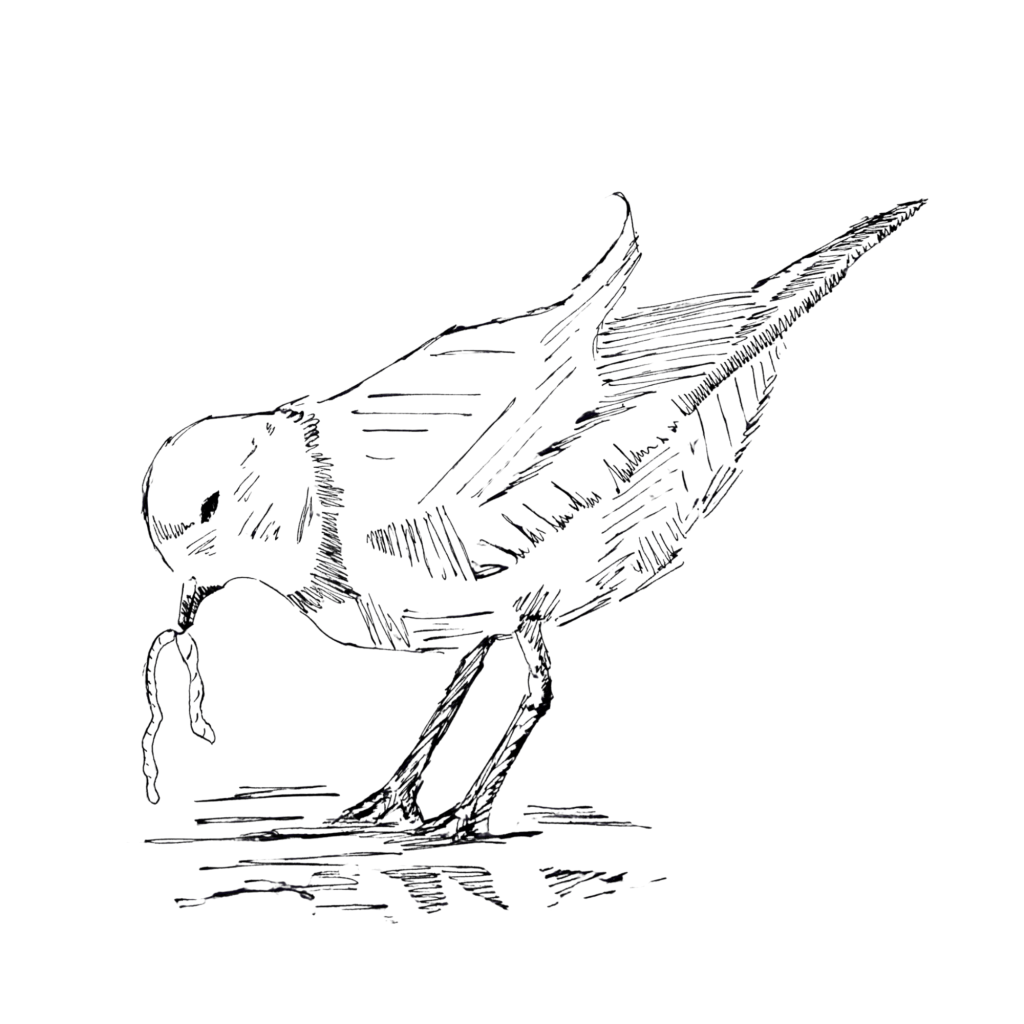
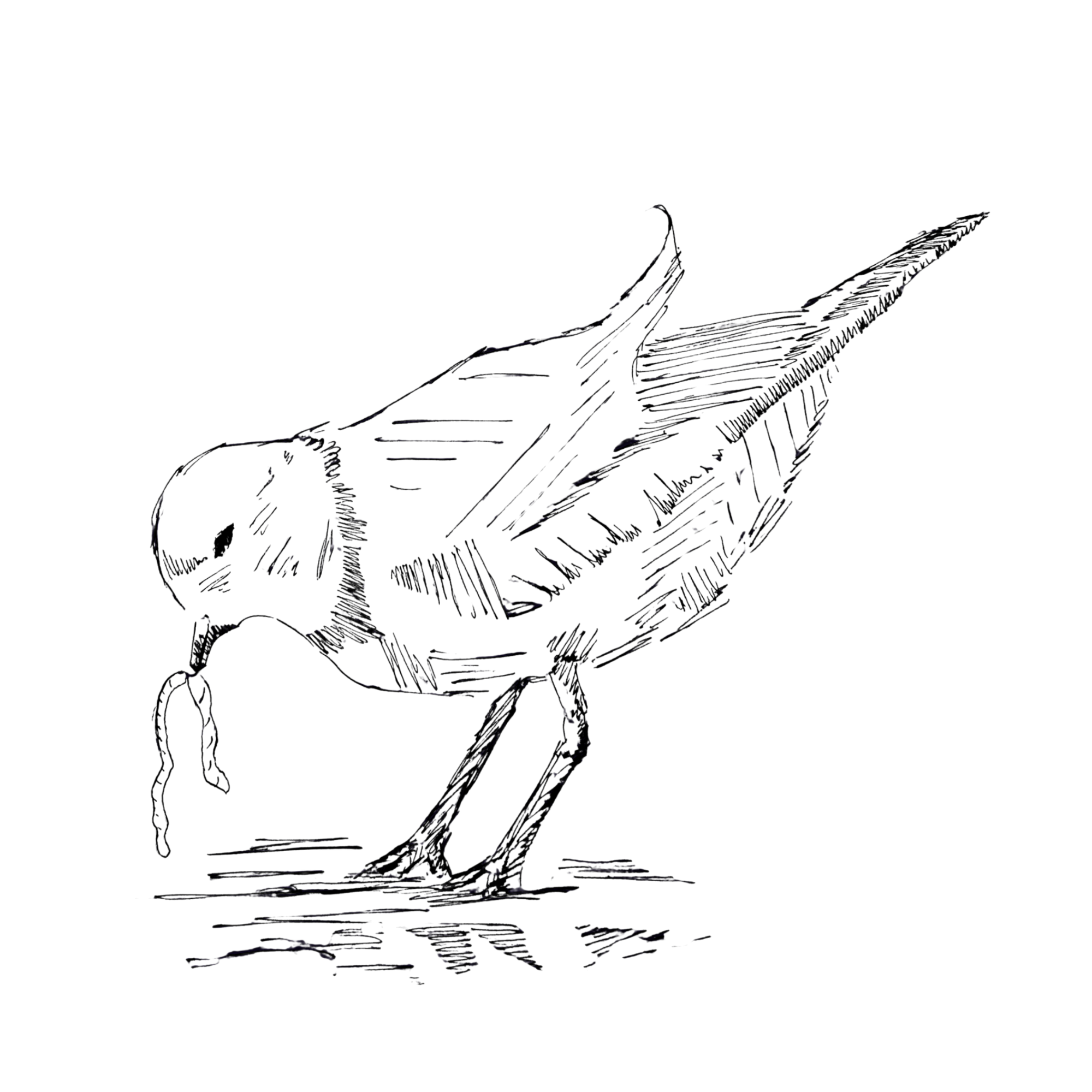
  • Charadrius melodus. Shorebird, skitterer, whistler, watcher. 

    I do think we all have our bird. If we don’t have a bird, we at least have an animal. If we don’t have even that, then I think what we need, instead, is a good look at life and our place in it. My animal is equally the black bear and the hare, and my bird is the plover. These things I know and these things I think about often because they are who I am and through which I see the world. 

    Only the piping plover, though, lives in my niche pocket of the world, and only do they live there in the winter. They do not breed here, here being a mere overwinter pit stop along their great migration from The Great Lakes to the Caribbean to all the places in between. Strange to think that a creature so intent upon a particular worm on my particular beach on this particular day in my particular life was once cresting the shore of Lake Superior or riding the gusts above Alberta. To come here, to this small spit of nothing on the southeastern Atlantic coast seems arbitrary. Surely there are greater adventures elsewhere.

    But no, it runs from my shadow. Here. 

    Plovers are then creatures of the winter. I, too, am of winter, although I was born in Spring and have lived in the fiery oven of South Carolina summers my whole life. My genetics dictate otherwise: short, stocky, luminously pale, made for Scottish winters. I melt and fade in the summer. It is a time for hibernation instead of activity. I sleep through the heat of the day and use the (relative) coolness of night as a reprieve to read and write and think. It is in the winter, then, that I reemerge into normal human activity.

    Like the plover, too, I skitter. I skitter from one dream to another, from one writing project to the next. I’m writing two novels at once in two very different veins. I write reams of poetry when the evening comes on. Sometimes I think I should up and move to Europe, drink dark coffee and disappear. Other days I throw myself into the fray of where I am and watch humanity in its intricate, delicate exchanges, come home from it all exhausted, start the process over. Kunitz often makes himself known: “I am not done with my changes.”

    That the plover is my bird comes at its cost, however. I would have been better off to choose the cardinal or the blue jay or fish crow or the grackle. These and many others stalk the backyards of almost everyone I know. They eat and drop store-bought seed for mourning doves and gray squirrels. Piping Plovers, like so much, are now classified as “threatened” in the southeast. Better off, I suppose, than the Great Lakes plovers who are “endangered.”

    Name them and weep: rising tides, erosion, over-development, salinization, the gross disinterest of people moving about their busy lives with heavy thoughts and heavy hearts. It’s hard to think of the environment when the bills arrive. Most people don’t even know about the proposed natural gas plant in the ACE Basin, one of the most biodiverse and fragile ecosystems in the southeast, home to innumerable plovers. Why should they? Those in charge do a damn good job of suppressing it. Progress is progress and it, with death and taxes, is inevitable. 

    And still, the plover comes.

    They run along spits and cuts and inlets toward the outrushing tide where, in brief seconds, they tear up seaworms and spring back as the tide returns. They run-and-pause, they foot tremble. They will do anything to feed. In other words, anything to survive.

    And then, when some unknown change in the wind blows its warmer grace, the plovers up and up and there they go – 

    But they’ll come back. They always do. Please, do.

    //

    //

    It takes great talent far superior than mine to make visual art. I try, and I fail. And so I stopped trying. But I have been infinitely blessed with talented friends who never did give up on those dreams, whose innate abilities as artists shine despite what I would call “the algorithm of consumerism.” They create art because they love it, because they were born to do it, and because they know that without it, there would be no point. 

    I asked my friend and fellow creative, Payton Mullinax (PM Projects) if she would be willing to foray into new territory and dream up a piping plover to represent my little corner of the internet. She said yes without hesitation. As is who she is, as is what her art is – one big, gigantic, YES to this world. And so now, I have the absolute delight to say that an independent, uncompromising, immensely talented woman has created my little plover – shall I name him? – who will forever and always sit at the corner of my writing.

    Thank you, Payton. Thank you infinitely. (Check her out on her instagram: @p.m.projects or on her website). 

    And, so, my little homage to the piping plover comes to an end. I hope we protect you, little one. If only selfishly, if only because you are a small and flighty part of me. 

  • I don’t have much to say on this poem except that no one wants to publish it, and so I’ll put it here as one more frantic kick against the system that has our president, in all his power, shouting into the ether: “Open the F*ckin’ Strait, you crazy b*stards, or you’ll be living in Hell.”

    A poem for this dying, cruel world.

    American Atrocities (Two Interjections)

    Today I am
    angry:
    angry as the fowl
    quickened from its
    still waters
    by the bruise
    of the rifle’s butt
    against a broad-
    breasted man.
    Angry that my collapses
    are so late in coming,
    have come at all,
    to my grotto of clear
    calm.

    That with the break of day
    came in its wake
    the history of the tide,
    how it reached back up
    and in from long
    recession
    and all memory
    of its high water
    lines faded, so soft.

    But me, (not fowl),
    I can mull.
    That a gun is a gun is a gun
    to a snipe
    is not so easy to one like me
    who saw it once in peace
    and only now
    has hunted
    its calamities down.

    [My father
    on the stretch of land
    fronting marsh
    took the shotgun
    and rang out
    twice perfect precision
    the clay pigeons,
    never shooting
    a thing that bleeds.]

    [We interject
    to bring this news:
    ‘you crazy bastards
    you’ll be living in hell.’]
    The clay will rain heavy
    upon the fields of democracy.

    So I’ll write this,
    if not an apology, a filling
    of the void,
    that which never happens:
    the safety latch,
    the jam,
    the failure to extract,
    the angry old man
    so angry
    that his day has been ruined
    has taken no fowl home.


  • Poem: “the new command”

    This past June, I was honored to have my poem, “the new command,” published in the third issue of Blue Moon Review.

    I often don’t like to discuss the inspiration behind particular works, as these inspirations are either entirely too personal or they derive from fleeting images and thoughts that don’t even entirely make sense to me. Often the initial catalyst has nothing to do with the final work, and its evolution is so convoluted that it’s not worth discussing its roots at all.

    That being said, “the new command,” is one poem whose composition was a clear burst of energy. I had that spark of inspiration, wrote it down almost immediately, and hardly changed it. That is very much not the case with most of my poetry.

    This particular poem was born after listening (for the hundredth time) to Billie Gentry’s “Ode to Billie Joe.” We all know this song, and if you don’t, please go give it a listen. It is a song that is haunting, alarming, horrifying in its casual views on life and death. There’s this repeating idea of something being thrown from the Tallahatchie Bridge, and people for decades have been trying to figure out what, exactly, was being tossed off into the Tallahatchie River. I, being sometimes morbid, always imagined it was a fetus.

    Looking into it more, others have conjectured that what was thrown was Billie Joe’s Vietnam draft card. I love that idea if only because it isn’t as disturbing. I also like the act of rebellion. But Gentry tells us that it doesn’t matter what was thrown off the bridge:

    “…the real message of the song, if there must be a message, revolves around the nonchalant way the family talks about the suicide.”

    –Bobbie Gentry as told to Billboard

    So much in life is taken for granted, including the end of life. I often think that is perhaps a defense mechanism. If we thought of all the horrible things that could happen to us, that do happen to us, we would be unable to leave the house. Life would, through fear, stop being life at all. And when those we love and cherish die, grief does abate with time. We don’t forget them, but we do learn to live with a new normal and understand, eventually, how to go through daily rituals without their guidance.

    If we didn’t, life would grind to a halt. 

    Take childbirth – if women didn’t forget, at some level, the sheer pain of childbirth, the population would stall. A new normal is assumed.

    This brings me back to “the new command,” which, after listening to “Ode to Billie Joe,” made me think on how I could have ever moved on from losing those who I have loved with an immense ferocity. I moved on because I had to, because – as horrible as it sounds – sometimes I must simply pass the peas and say, “What’s done is done.” Otherwise, how would we, as a species, as individuals, continue to function? 

    Perhaps the only thing that gets us through the day, besides an assumed sense of the casual, is love. It’s almost laughable to put that in writing. The word love is used so casually (there’s that word again) that it contains almost no weight. I love gin and tonics and I love my husband, but I do not love them in the same way or at all equally. But that’s another discussion for another time. What I mean to say is that, unlike “Ode to Billie Joe,” I felt that my poem had to end on a higher note if only for my own sanity. 

    I didn’t have to think too hard about those I love. I wrote this poem at my desk not ten feet from my husband. His small movements – castling on the chess board, speaking low to his friends, drawing lines soft and beautiful with his charcoals – are the actions that make me remember what life is and who it is lived for. 

    And although I don't exactly believe in reincarnation, I also don't disbelieve. I do not know what is out there or how God works or what His ways are. I don't think they're for us to know. But I do know that, in some other life, neither my husband nor my thousand loves were ever some lowly, crawling thing. For each and every one of them "look[s] at hate and me and say[s], what grace in everything."

    the new command

    that said, I’ve had it
    spades, death.
    who has come
    this far
    and not?
    who has not passed
    the peas and said who died
    today, who has not,
    who is near,
    who went well
    and who went
    hard, who crumbled,
    withered, whose spirits
    set the standard,
    settled Heaven
    like a worn boot,
    what or who went back into
    it, back into life,
    a bather in a sea
    of other bathers, wet and raw
    and still believing,
    seeing earth’s morning once
    again, the fire of a sun
    on sea, the single mountain,
    town, the skirts
    of women, then –
    (ask me how I know you
    weren’t a wasp
    or some low thing.
    you walk the world
    and look at hate and me and
    say, what grace in everything).

  • I once read somewhere that English is the language of the marketplace. It is a commodity language, and that is precisely why it has gained such popularity. It is malleable, meaning that it can change as economies change. Economy as in monetary systems, but also as in conquest. The English language has morphed under every regime change. This is why English, though technically a Germanic language, contains influences of French (Norman), Irish, Norse, Latin, and a host of adopted words from across the planet. This is precisely why I cannot understand my German cousins, despite our similar roots, as they speak their complex compound words across the table. It is also why English is the most versatile of all languages and contains the fastest growing dictionary. 

    English may have its trickier bits – explain “their, there, and they’re” to a non-native speaker – but compared to other languages, such as Romance languages, we do not have gendered nouns, alternating verb endings, noun cases. Even if you were to mix up the royal order of adjectives (example: the unbelievably giant ancient rotund mauve Cypriot) we could still understand what it is you are saying, and mistakes often lead to colloquialisms and dialects. This is not to mention that the English language utilizes the Latin alphabet which almost all people of the world can now read and pronounce. Thus, other alphabets – Cyrillic, Arabic, Hebrew, etc. – are now easily prised apart and understood through their Latinate equivalent. 

    What I am saying is that I adore English for these very things, and what I am also saying is that I feel English deeply lacks something vital.

    The English language lacks a sense of place. Therefore, English often is, but does not have to be, a tool of forgetting.

    I initially decided to write this specific post because I stayed up late last night thinking of my favorite words (my life is very, very boring). “Ablution” is probably my favorite word of all time. It is a word derived from Middle French and Middle English that defines the act of ritual bathing for religious purposes. Another favorite word is “Loblolly,” which, for those who do not live in my part of the world, is a type of pine tree found across the southeastern United States. A quick Wikipedia search (apologies to my high school English teacher) tells us that “lob” is a type of thick, bubbling porridge, while “lolly” is an old British term for “broth, soup, or any other food boiled in a pot.” As these trees are normally found in swampy areas, I suppose it makes sense.

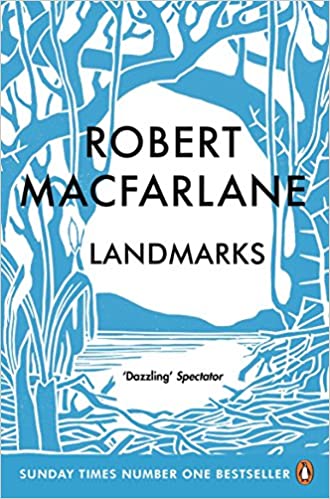
    I stumbled across a word recently that so perfectly captures a very specific, very rich ritual in my life, one that I still practice even though others have grown up and moved on from frivolities like these. It was found in Robert MacFarlane’s Landmarks, a delicious book that compiles nearly-forgotten words across the British Isles, spanning from the Channel Islands to the very tip of Shetland, out to the western reaches of Northern Ireland, to the land of my ancestors in the frigid east. It was this word, in particular, that stopped me:

    “Glassel (n): A seaside pebble which was shiny and interesting when wet, and which is now a lump of rock, but which children nevertheless insist on filling their suitcases with after a holiday.” 

    (Check out this wonderful article in The Guardian).

    I am an avid collector of glassel. My first encounter with it is beyond my reckoning, perhaps somewhere in Western North Carolina, but the moment I fell in love with it was on a trip to Scotland in 2017. When not shearing sheep or picking raspberries on the farm of a well-intentioned, if not eccentric and slightly combative, Englishwoman, I was able to take small side trips to the towns and villages of Aberdeenshire. Portsoy, along the Moray Firth, was where my love of glassel was first solidified for there, all across the rocky beaches, were stones glittering red and green just beneath the surface of that clear, cold water. These stones are colloquially known as “Portsoy Marble,” which, in reality, are serpentine fragments dislodged and discarded from an 18th-century quarry. Fun fact: this serpentine was used to create the fireplaces in the Palace of Versailles. 

    Landmarks by Robert MacFarlane (Penguin Books, 2016).

    P.S. There is no monetization here. Only a deep and abiding love of Robert MacFarlane.

    But, like all glassel, these stones need to be polished to shine. Once taken out of the water and sufficiently dried, these rocks look like nothing more than smooth lumps of gray. Nevertheless, they sit in a place of pride on my windowsill just above my writing desk. When I’m feeling bored, I’ll put them into the sink and watch the colors flood back under the tap. It’s the little things.

    I have had a hard time unearthing (no pun intended) the etymology of “glassel.” It looks to be a surname with Scots-Gaelic roots. “Glas,” means green or gray, while “ell” is most probably related to a specific place. (Thank you, ancestry.com. I am well aware my sources are not academic, but stay with me.)

    This makes sense, in a way. My stones are green and lush under the rolling waves, gray when taken from its natural setting. Green and gray, gray and green. Totally and completely reliant on place to reveal its full beauty.

    And so, a place-specific word created by a place-specific people was adopted into a language of the marketplace. No wonder it has been almost completely forgotten. Glassel has no worth. At least, no monetary worth. Collecting glassel is, too, often a childhood hobby, abandoned by adults when they eventually give up on the magic of the world. Unfortunately, adults are keepers of language, and we usually only keep what we need. 

    In my community, we have little need for the word glassel. Here, geological forces have eroded the Appalachian Mountains into strands of fine sand, littoral zones of dark, muddy water, a few lettered olives here and there. We do not have this word because we do not have glittering oceanic stone. But what words do we have? I can think of none.

    I have descriptors, but I have no words for the state of these things. I can describe sand as fine or coarse, hot or clammy-cold, white or beige. But I do not have a singular word to describe the albedo effect of the sun on the sand when the world goes blind and all you hear are tides and tern. I do not have a word for the sand when it blows so hard against your shins it feels like knives.

    And so, I often feel like a passerby in the very ecosystem into which I was born. If I have no way to describe it, to describe the very tiny, minute precipices of nature falling from one state into another, how can I hope to be fully at home? How, then, could I ever hope to protect this home? 

    This language-amnesia is, in my very humble and often very dramatic opinion, one of the catalysts for environmental degradation. How can we love something if we do not have the right words for it? Loving, after all, is communion. And communion is most readily accessible through speech. 

    I have no solution for this. We killed and starved and drove away the first human settlers of these Sea Islands. They surely had words. I should very much like to hear them.

    My only suggestion is that, perhaps, we should do what English does best: adopt words to make our meaning clear. Maybe, on these shores, glassel is the sparkle of broken shell and sharks’ teeth at a low tide. Maybe we can use another one of MacFarlane’s collected words, such as “pir,” or a “light breath of wind, such as will make a cat’s paw on the water.” Maybe we can substitute “cat’s paw” for the hoof of a white-tailed deer, a suburban dog at sunrise, the gentle nuzzle of a wild boar (do they do anything gently?). 

    Maybe I’ll come up with my own word one day for the confused head cock of a piping plover before its dives and jerks up a worm the length of its breast. I wonder if it knows how lucky it is to be walking that long stretch of beach thinking only of food, not knowing or ever caring that I am always thinking of it.

  • A Welcome.

    Admittedly, this is not something I ever thought I’d do. Beyond the time commitment, the vulnerability, I simply did not see the point of a blog. I have a journal, instead. A nice, black Moleskin that sits at my desk next to trinkets and findings that mean everything to me and very little to anyone else – a brass fish paperweight from grandfather’s desk, two dolphin vertebrae found on a spit at low tide, rocks shot through with granite from Portsoy, a small town set rigid against the Moray Firth. Like these little, frittering things, my opinions mean little to anyone else. My dear, dear family, friends, and husband can only take so much of my conjecturing, and even the foxhound sometimes turns tail and climbs into my (her) chair when she’s had enough of my voice. And so, of course, I write it all in the journal until my hand cramps and I feel satisfactorily empty inside. That good empty, the one where you can sleep at night without thinking of every ill in the world. Or almost.

    But very rarely is the journal legible. When I die, I think I’ll have them all burned so as to save the embarrassment of having someone watch me, in quite real time, work through hard thoughts. It’s like having someone watch you pass a kidney stone. Really horrible stuff.

    I also have a sort of curse. Not a really bad one or anything, not like the curse of the Kelpie on St. Vigeans (good story, look it up), but one perhaps equally as unnerving and frustrating: I convince no one when I speak. I convince not even myself. It’s always been this way, and as with so much, it’s only getting worse with age. Passing my thirtieth birthday, I regress more into my own becoming, and I find that I am not as quick on my feet when told to expound upon myself or my opinions. There is, of course, an expectation for a damn good argument, as I am someone with strong convictions and interests (for better, for worse). But I am so often silent. The world is in my head, not out there.

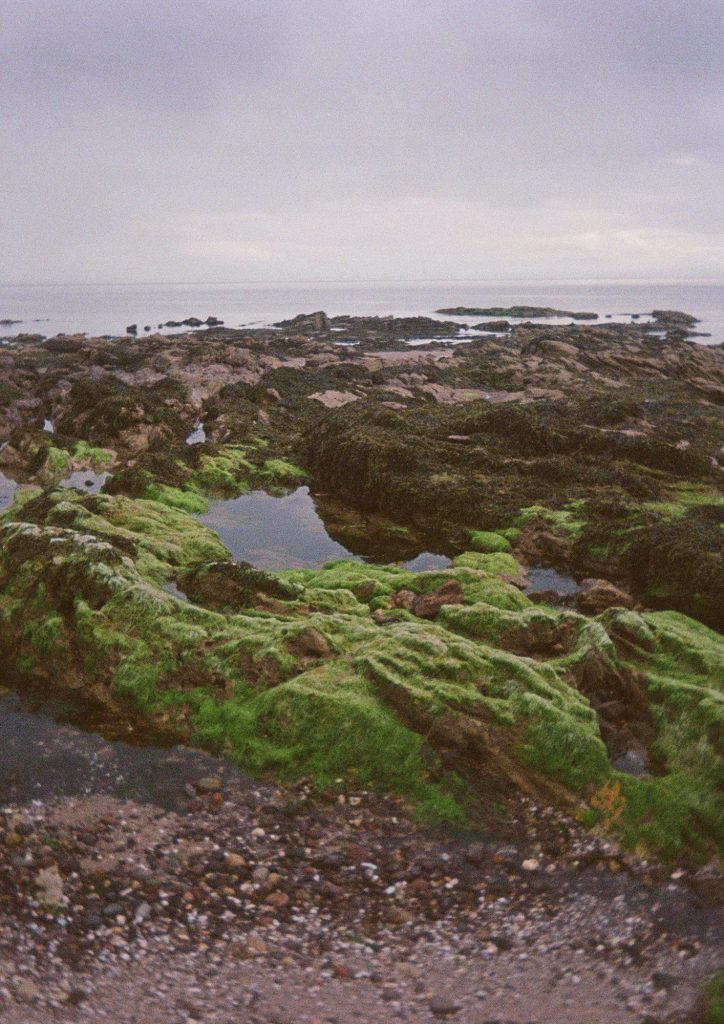
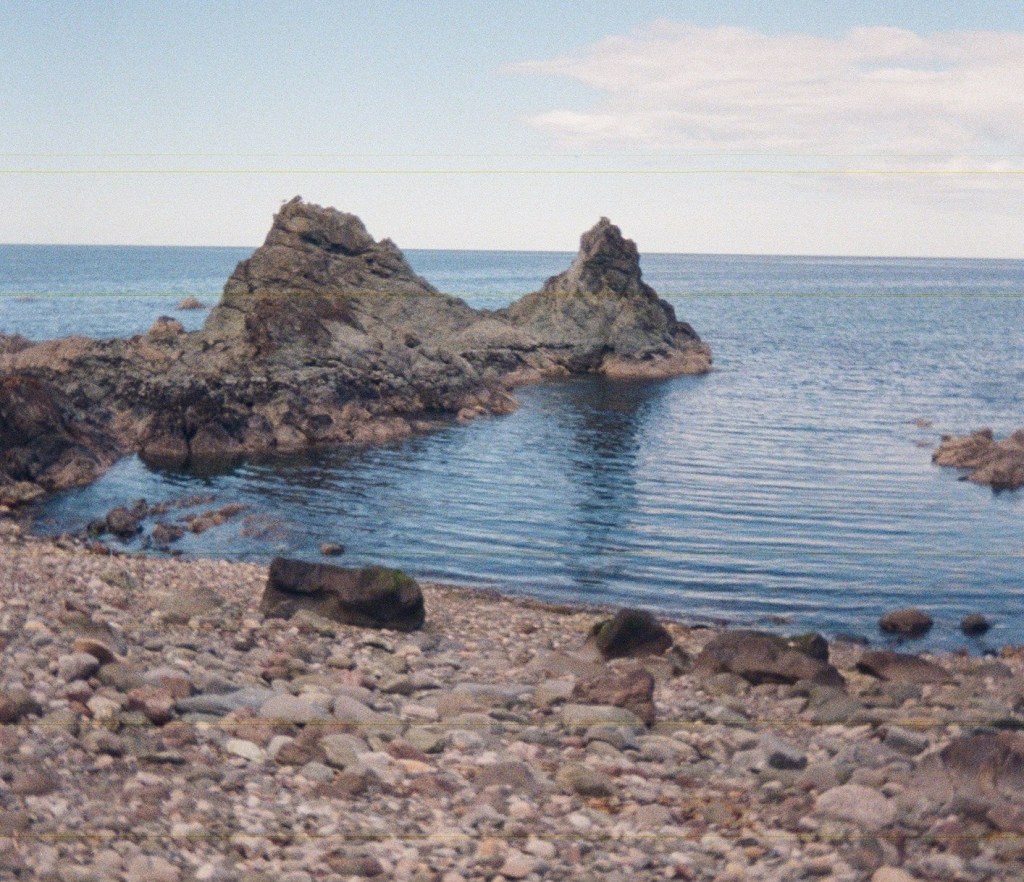
    Photo: Jewel Green of the Moray Firth, (Lower Largo, Film). 

    It’s not until much later, often in the shower, that I think of a clever response and am able to fully flush out why I feel a certain way. Sometimes these arguments are more like dissertations and hover around topics like Medieval art or Scottish folklore (hence the St. Vigeans Kelpie), both of which mean very much to me but are of little consequence in the grand scheme of the turning earth. More often, I am trying to explain how I think we are on the precipice of so much: a dying Earth, a literacy crisis, an unknowing of ourselves as a species. And how to explain to someone something that has owned your thought-space for so long and has paid very little rent.

    And so the blog. This little nothing.

    This is to say, I expect no one to be interested in this little blip on the vast expanse of the internet. This is purely for my own enjoyment, for my own peace of mind, for my own ability to explain the many whys of my many thoughts.

    Perhaps my words will be a sort of balm, a calm, despite their heaviness. So much of what I believe in boils down to the sheer fact that this world is turning too fast and it is up to us writers, us artists, to make sense of it. If anything, I hope you can enjoy the pictures, the poems, the sense that the world is so much deeper and more beautiful than ever we imagined, if only we give it our attention and grace. 

    This is all to say, welcome. This is a strange little part of myself and is, simultaneously, a very big part of myself. I am a writer, and I am a lover of the world. And if I do nothing great with my one and precious life, at least I’ll have said my peace.