Good books come like asteroids, shooting through and out your life, their tails raw and glimmering long after the phenomena itself has passed. Years of work, tears, toil – we read books in only a day, a week, a month. It flashes against and upon us, and then we move on. But it is what stays with us that is important and why, at least for me, I continue to write when doors continually open down the hallway of my imagination and I think that I’ll never get out of it.
A few comets in my life: Small Things Like These, Claire Keegan, The Sea, John Banville, and all poems by Heaney and Kavanagh. Recently I found myself crying until I wheezed over a book meant for children, Aubrey Hartman’s The Undead Fox of Deadwood Forest. I’m not quite sure it was ever meant to be that heartbreaking, or maybe I just read it in that vulnerable blip of time where the body winds down from a hard day and eases itself into rumination on everything rough and cruel: how hard it is, these days, to live and breathe in a world with such abject poverty, illiteracy, contempt for the other (see: librarianship). But it went through me as only grief can, and when I’d finished my crying and made a cup of tea, I was astonished at how buoyant I felt. Something had come and gone and had left me with a gift that surpassed my understanding. Catharsis, or more accurately, the emotional sign of a book well-written.
This book, like so many books written for children, features anthropomorphized animals in cloaks and monocles, mushrooms fields, the relationships of unlikely creatures who find meaning in difference (a badger and a fox, for one). It is precisely these elements that make a children’s story entertaining and suspend reality for long enough to get a message or two across, whether they be messages that life is not always kind or that children’s stories should not have messages at all because much of life doesn’t have a message, except maybe the lesson that we are alive and that it is important to always remember that knowing you’re alive is easily forgettable.
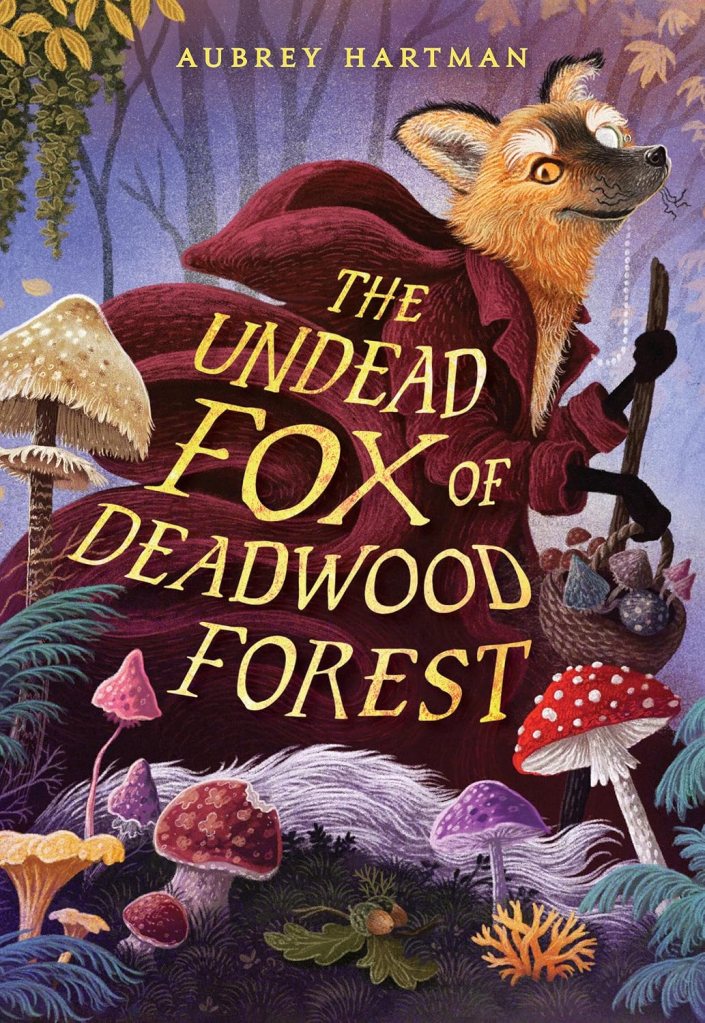
The Undead Fox of Deadwood Forest, Aubrey Hartman (Little, Brown 2025)
It’s why one of current works in progress is a children’s books meant for readers who are just now growing into their personhood, realizing that they are a part of a greater community of creatures (both human and otherwise) and that the world is more strange and more beautiful than perhaps parents – and other jaded adults – make it seem. It is these books (usually read between the ages of 6 and 12) that directly influenced my interest in the natural world and in folklore, and so I suppose it’s not strange at all that a book like The Undead Fox of Deadwood Forest had me crying big, joyous tears that I could not explain away.
The book is not only about life’s greatest quest, death, but about respect and preservation of the natural world. I don’t give anything away by saying that there is a heartwrenching scene wherein destructive, loathsome children come upon a pristine setting, and like we see in Adams’ Watership Down, the clash of chaos and peace is never a nice one. We know destruction for destruction’s sake is wrong, and yet every day we commit these very crimes.
What my writing is, in general, is apology. It is a grasping at knowing what I’ll never know in regards to how deep and how long my personal destruction has been. So much of the world burns safely away from my sight. This emotion, this “climate doom” goes so deep in and far from me that the only thing I can do is read about anthropomorphic foxes going about their daily business, watching them in their impossible worlds balancing life against death and knowing themselves fully as animal.
And so, I’ve decided to share poem I wrote for the natural world. A love poem. A poem that I edited heavily after reading Aubrey Hartman’s book, so a thank you to her, though she’ll probably never see this. A vibrant comet amidst decay.
For the Earth-Spirit
No, I do not think the good of you is diminished
in the house of the world, that the things that have
flown their arrows at you make you any less
you as if every point could rip holes through and out,
and by them, I could see the sun easting
over the horizon and thereby could not see you for shadow.No, I do not think that what has been done to you
comes more naturally than what could be done,
and as I read this poem by a tree on the bank
of a dead river, I do not think it does good at all
except that I love you for what’s existence,
your sway away and toward everything.Yes, and the fact of your holiness, I watch it rise
and go before me, arch my every to see it through,
the backside of my shadow, the mossy ground
(your sheltering body)
and in this dark, fern unfurl and through them
I walk and give thanks to what I think I know is true.


Comments
One response to “Comet: Words and the World”
[…] Comet: Words and the World […]
LikeLike