It’s been nearly two weeks since I’ve written anything but fiction. I have had my head down, typing away at my manuscripts, holding on to my last bit of sanity as I dive into voices and people and journeys that are not my own. Some of these characters are not even my own species (won’t get too deep into that just yet, but my last post certainly delves into my love of anthropomorphic woodland creatures who harbor more humanity than do most humans).
Beyond writing, I have been reading. Devouring, really. A few titles as of late: When the Sky Falls: A Human History of Shooting Stars by Jade Angeles Fitton, A Frozen Woman by Annie Ernaux, Mestra, a short story by Madeline Miller.
I also finished a book that somehow dodged my high school syllabus: Aldous Huxley’s Brave New World. American high schools tend to divide themselves into two camps: those who read Brave New World and those who read 1984. I haven’t met many who read both in class, as dystopia is not a very “fun” topic and I don’t think it holds well the attention span of most high schoolers (after all, most of us don’t think that what’s in those books is ever going to happen, and we rarely realize that it already has). My high school was on the 1984 train, and I’m thankful for that, as I think my teachers would have had a very hard time keeping the class under control while Huxley shouted “orgy-porgy” every other line.
Having read Brave New World later in life than most, I have several thoughts that will take further time to mull over, to figure out. I love it and I don’t. Not that my opinion really matters. It’s a masterpiece, and it is strange. I’m not sure that what it says means what I think it does. But I am happy to have read that Huxley himself was not wholly satisfied with his ending in later years. In the edition I read, Huxley bemoans the fact that he did not have a “third way” between “civilization” and “savagery,” and I think that thought comes only from maturity and the ability to look back and scrutinize one’s own work.
Two very specific passages from this book, however, remain beautiful and true, and they are thus:
“That mania, to start with, for doing things in private. Which meant, in practice, not doing anything at all. For what was there that one could do in private. (Apart, of course, from going to bed: but one couldn’t do that all the time.) Yes, what was there? Precious little.”
And, further down the page:
“‘Then what’s time for?’ asked Lenina in some astonishment.
Apparently for going [on] walks in the Lake District; for that was what he now proposed. Land on top of Skiddaw and walk for a couple of hours in the heather. ‘Alone with you, Lenina.’
‘But, Bernard, we shall be alone all night.’
Bernard blushed and looked away. ‘I meant, alone for talking,’ he mumbled.
‘Talking? But about what?’ Walking and talking–that seemed a very odd way of spending an afternoon.”
Walking and talking, being alone by oneself or being alone with someone who you love and who is therefore a part of you. Being alone without it being lonely at all. Being alone to read books like this very one that bemoans the world we’ve made for ourselves while that very world turns outside of your room, furious and hurried and gorging and angry.
What I’ve been doing these past few weeks is remembering the art of being alone in a world that, since Brave New World’s publication in 1932, has only accelerated this communal frenzy.
What I don’t think Huxley could have foreseen, nor anyone, for that matter, is social media, something I deem to be one of the greatest evils of our time. Caveat: I use Instagram, and I hate that I use it. But it is how I keep tabs on bookish news, how I follow my favorite writers and illustrators, and, unfortunately, how I fritter away my time. I’m actively working on rectifying that latter bit. But we all have our vices, don’t we?
But I’ve been reading quite a bit about the societal effects of social media, on how it has skewed our morality, our sense of self, the very notion of aloneness.
One book I recently read that skates along these lines, though it was also published before the rise of social media, was Neil Postman’s Amusing Ourselves to Death. There was a very particular part of this book, though I have no direct quotes (forgive me), that defined the current social currency in far clearer terms than I myself have ever thought about it. Money is no longer the sole catalyst behind what we, as a society, define as “success.” Now, too, fame must be involved. Not fame as in A-listers, not fame as in Nobel Prize winners. Fame as in that five-second clip that drives one to a week-long, maybe month-long, internet stardom.
I was discussing with my husband only the other day how quickly internet fads come and go. How everyone knows a specific video or meme or saying, how these people shoot from nothing into glorious golden light, and then, their usefulness exhausted, they fade out just as quickly. They are used, abused, forgotten. It doesn’t really matter what they did or said in the first place. It was probably funny or shocking. Maybe even obscene. I can almost guarantee that it was not profound. But it did hold our attention – a rare occurrence in a society of depleted attention spans.
Fame comes at many levels, though. You do not have to go “viral” to receive an ounce of attention. What social media has done has accentuated the need for us to post about what we do and what we think (take this blog, for example) because, without this evidence, without this cultural and societal approval, it is as if we haven’t done or thought at all. Why hike if you don’t show the mountain, show the calories burned, show that you are of a certain brand of person who delights in the natural world and so identify with all that goes along with it (Patagonia jackets, granola, craft beer). I’m joking, but I’m also not.
We so rarely take a walk in the woods for the sake of it. A thought of delight hardly ever enters my head without the simultaneous need to share it with my friends. After a long day of writing, if I’ve found it successful, I want to gloat. If it’s been miserable, I want to moan. We, I, can hardly do anything alone these days. The mystery has flown.
So even in these past few weeks where I have been more alone than I have in some time, I was not alone at all. I’ve posted the dog, the bluster of the beach, birds and quotes and books that I find say something not only to me but about me. And for what?
It’s all very strange, isn’t it? Who really gives a damn?
And yet, here we all are. Sizing each other up in a matter of nanoseconds. Putting ourselves into boxes labeled Interests, labeled Aesthetic.
This is only evolutionary, I’ll give it that. We’re a communal species. We need each other. But the constant scrabbling for attention has missed the mark of the true definition of community, what it means to be each other’s greatest advocate without the infinitesimal scrutinizing of the online feed. No wonder I close Instagram with a migraine almost every time. How can the brain that’s just understood fire fully understand the virtual world?
To be private, to really take yourself from out of things, to not have everyone know what you are doing all the time, that is the ultimate rebellion. We are in a society of surveillance, in so much as our internet traffic is tracked, our daily movement seen through CCTV, through Flock footage that scans our license plates. God, and those Ring Cameras. Every time I walk the dog I hear that chime and that nasty voice drawl, “Recording in Progress.” This isn’t to say I’m a Luddite, that it’s all bad. But it is something to be aware of and to acknowledge. How quickly this can all turn sour.
I guess the solution is to make oneself unavailable, in so much as it is possible. The less I rely on the internet, the less data there is to mine. The more I write long-hand, the fewer words AI can scrape (I’m looking at you, Google Docs, Word, yes, even you, WordPress). I can do nothing about being watched by others, but I can make my interactions mean something.
And let us create.
Make yourself a being of creativity.
Create something from nothing in a world that thinks it knows your every step.
That last bit reminds me of Wendell Berry’s poem, “Manifesto: The Mad Farmer Liberation Front.” His final stanza has the great clarion call to uniqueness, to personal oddity.
“As soon as the generals and the politicos
can predict the motions of your mind,
lose it. Leave it as a sign
to mark the false trail, the way
you didn’t go. Be like the fox
who makes more tracks than necessary,
some in the wrong direction.”
Take a walk, make tracks. And if you must talk, talk to your loves, talk to yourself. I know I do.
And so what if it’s odd? At least it’s your own oddity. As the future has grown so close to Huxley’s predictions in so many ways, mere aloneness is subversive.
This is what I’m telling myself in order to get through a life dedicated to the loneliest profession of all: the writer. And in writing, I hope to practice Berry’s final line in his poem, the line which states simply, states with a government of hope:
“Practice resurrection.”
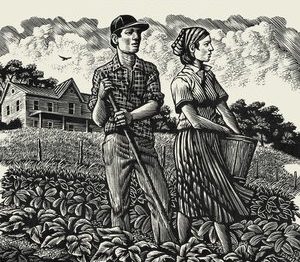
Image from the cover of Wendell Berry’s Roots to the Earth, illustrated by Wesley Bates.

